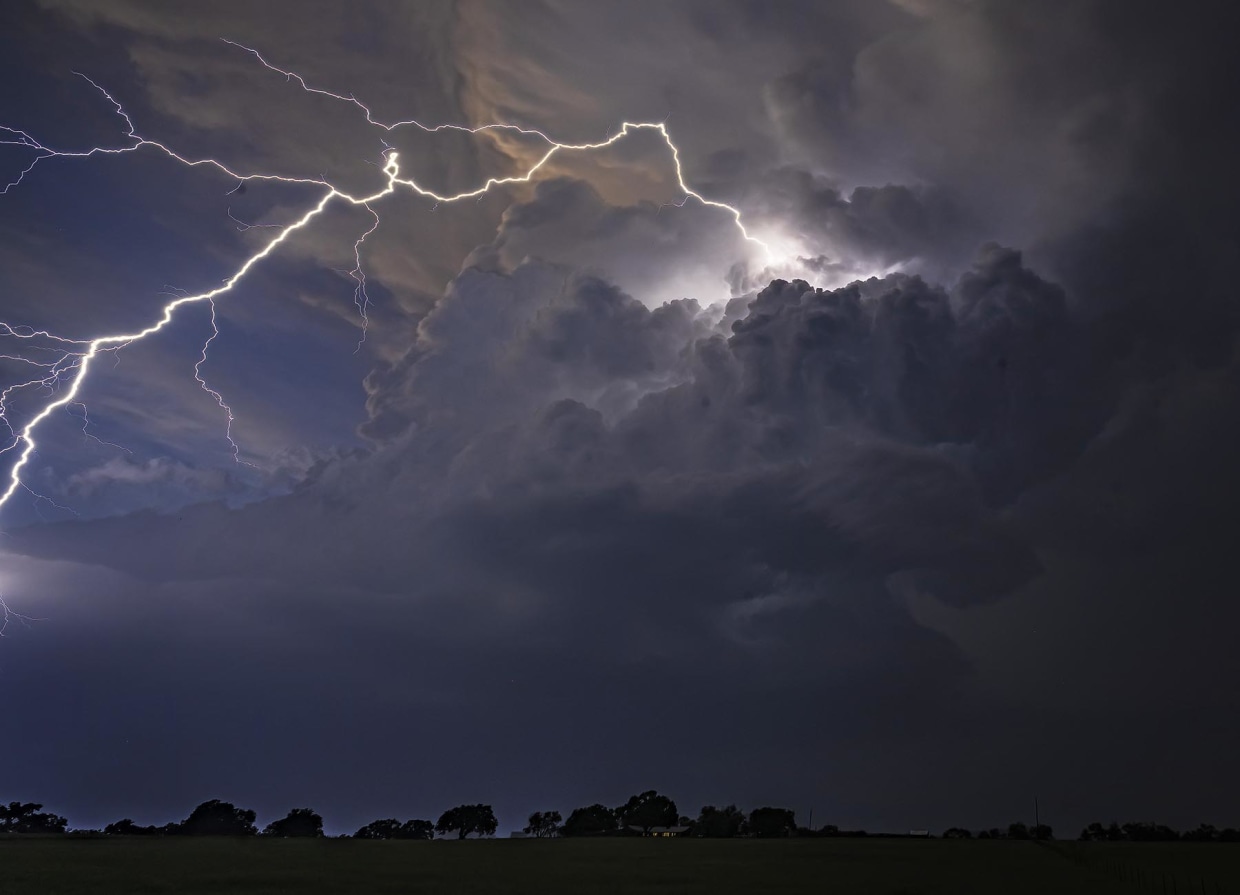
Lightning ranks among nature’s most potent and unpredictable occurrences, capable of both amazing visual spectacles and significant destruction. Not long ago, an exceptional incident drew the focus of both weather experts and the general audience: a lightning strike spanned an incredible 515 miles, traversing the airspace over three distinct states. This occurrence has established a new benchmark and provides valuable understanding into the behavior and potential of lightning in extreme weather scenarios.
The lightning strike occurred during a large storm system that swept across a significant portion of the region. What makes this bolt extraordinary is its unprecedented length — a continuous flash covering over 500 miles. Such an extensive reach challenges previous understandings of lightning’s range and demonstrates how dynamic and far-reaching electrical storms can be.
Lightning forms when electrical charges build up within storm clouds, creating a potential difference that eventually discharges as a bolt seeking to balance this charge. Typically, lightning bolts are much shorter, often confined to a few miles or even less. However, under certain atmospheric conditions, lightning can travel longer distances horizontally, creating what is known as a “megaflash.”
This record-breaking bolt stretched through three states, illuminating the sky over a vast area. It was detected and confirmed by advanced lightning mapping technology that tracks electrical activity in storms. These instruments provide precise data on lightning strikes, helping scientists analyze their length, intensity, and frequency.
The scale of this event highlights how severe weather patterns are capable of producing lightning that extends far beyond common expectations. Long lightning flashes like this are usually associated with large, intense storm systems, including supercells or fast-moving squall lines. The atmosphere during these events is highly charged, allowing electricity to travel over great distances before grounding or dissipating.
The implications of this discovery extend beyond setting a record. Understanding how and why lightning can travel such distances is crucial for improving weather forecasting and public safety. Lightning is a major hazard, responsible for numerous injuries, fatalities, and property damage annually. By studying exceptional cases like this, meteorologists can refine models to predict lightning risks more accurately and warn communities effectively.
Moreover, such extensive lightning bolts may influence other atmospheric phenomena. For example, the energy released in these strikes can affect local electric fields and even contribute to triggering secondary lightning or influencing storm development. The interaction between lightning and atmospheric chemistry also plays a role in the formation of nitrogen oxides, which impact air quality.
From a technical viewpoint, understanding that lightning can stretch across several hundred miles is crucial in the planning of infrastructure and security systems. Energy networks, telecommunication systems, and transportation infrastructures need to factor in the dangers presented by these intense electrical occurrences to reduce disruptions and risks.
Public awareness about lightning safety is also essential. Despite its spectacular appearance, lightning is dangerous and unpredictable. People are advised to seek shelter indoors during thunderstorms, avoid open fields, tall objects, and water, and wait at least 30 minutes after the last thunder before resuming outdoor activities.
This record-breaking lightning flash serves as a reminder of nature’s incredible power and complexity. While lightning has fascinated humans for centuries, events like this demonstrate that there is still much to learn about its behavior. Continued research using modern technology will help deepen scientific understanding and enhance preparedness for severe weather.
The identification of a lightning bolt extending 515 miles over three states represents a notable advancement in meteorological science. It highlights the remarkable capabilities of electrical storms and emphasizes the need for continuous exploration of lightning phenomena. This occurrence not only establishes a new standard but also promotes increased focus on lightning safety and atmospheric research, which aids communities and enhances understanding of the natural environment.