

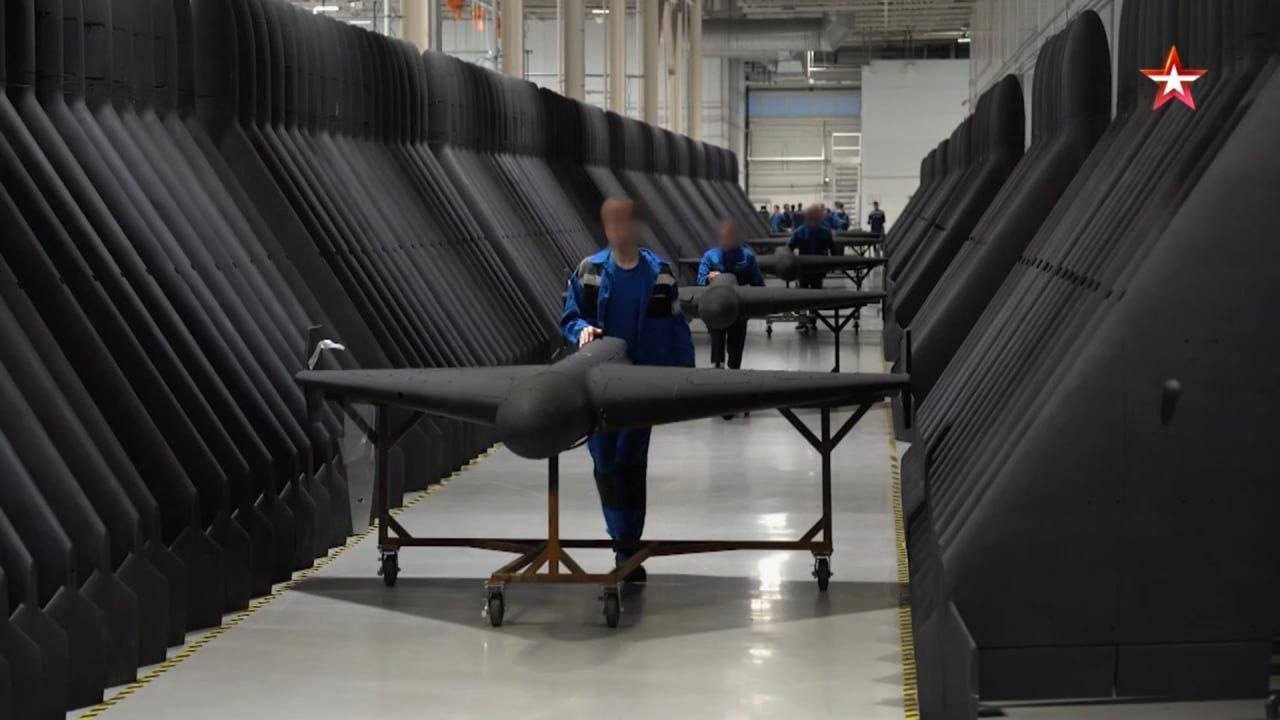
A high-security industrial site in Russia, previously kept under wraps, is now drawing international attention due to a significant and rapid transformation. Recent satellite imagery reveals major expansion efforts at a facility believed to be central to the country’s drone manufacturing program, while Russian officials have simultaneously allowed a rare look inside the plant—a move that has raised eyebrows among defense analysts and geopolitical observers.
The site, located in the Alabuga Special Economic Zone in the Republic of Tatarstan, appears to be undergoing extensive development. High-resolution satellite photos show a surge in construction activity over the past year, with new buildings, expanded infrastructure, and what appears to be enhanced logistical capacity now visible from above. These changes suggest a substantial investment in scaling up unmanned aerial vehicle (UAV) production—likely in response to the evolving demands of Russia’s ongoing military operations.
While satellite surveillance has offered one view of the developments, Russia has taken the unusual step of publicizing part of its drone manufacturing process. State media outlets recently aired footage from inside the facility, showcasing assembly lines, components, and technicians at work. Though tightly controlled and likely curated to serve strategic messaging goals, the footage marked a rare instance of transparency for a sector traditionally shrouded in secrecy.
En este doble anuncio —tanto a través de observaciones independientes como de medios aprobados por el gobierno— se resalta la creciente importancia que Moscú otorga a las capacidades de los drones desde una perspectiva estratégica. Los sistemas no tripulados se han convertido en un componente esencial en la guerra moderna, utilizados para reconocimiento, identificación de blancos y ataques ofensivos. Su utilidad en zonas de conflicto, incluyendo Ucrania y más allá, ha llevado a un mayor enfoque en la producción y el desarrollo tecnológico dentro del sector de defensa.
Defense experts analyzing the satellite images point to several indicators of accelerated expansion. Among the most notable are the appearance of new structures consistent with production halls or warehouses, the extension of transport corridors, and the installation of support infrastructure, such as power and communications systems. These elements together indicate a move toward higher-volume output and greater operational autonomy.
The site’s placement inside a Special Economic Zone provides benefits like tax breaks, efficient logistics, and decreased regulation, all aiding in quicker development schedules. These zones aim to draw in investment and foster innovation, and here, they seem to be fulfilling a dual role by encouraging military-industrial expansion.
Russia’s choice to exhibit the site could be partly aimed at conveying a message—both within the nation and to the world. On one hand, it indicates assurance in the nation’s production abilities and a wish to demonstrate strength despite sanctions and trade restrictions. On the other, it might seek to shape views of technological equality or dominance, especially amid ongoing global tensions and military positioning.
Analysts point out that the facility seems to prioritize the construction of UAV systems that have been commonly used in recent conflicts. This encompasses loitering munitions—drones intended to remain over a target site prior to striking—and reconnaissance variants. Some sources indicate that manufacturing might entail authorized or reverse-engineered designs, possibly utilizing foreign technology or parts.
However, questions remain about the supply chains supporting this growth. Western sanctions and export restrictions have aimed to limit Russia’s access to advanced electronics, optics, and aerospace-grade materials. While some domestic workarounds and third-party channels may mitigate these constraints, the sustainability of large-scale drone manufacturing under such conditions is uncertain. Analysts continue to watch for signs of how Russia is sourcing critical parts and adapting designs to available materials.
The extent of the growth also carries wider consequences for both regional and global safety. As UAVs play an increasingly crucial role in military strategies, one country’s swift enhancement of its drone proficiency might encourage others to similarly increase their capabilities, possibly resulting in a broader competition of unmanned technologies. Additionally, the widespread use of drones highlights worries about asymmetric warfare, where even small financial commitments can provide notable strategic benefits.
From a technological standpoint, the footage and satellite data reveal a blend of manual and automated processes within the factory. Workers are seen assembling components by hand, but some areas feature conveyor lines and machine-assisted production tools. This hybrid approach suggests that while Russia is advancing its capabilities, it may still rely on labor-intensive methods in the absence of more sophisticated manufacturing infrastructure.
Moreover, besides military factors, the evolution of the site indicates an increasing movement towards incorporating dual-purpose technologies—items and systems that can be utilized for both civilian and defense needs. The drones employed in agriculture, infrastructure analysis, or emergency situations may have similar basic parts to those used in military versions. This convergence makes it more challenging to separate completely commercial production from strictly military production, making it difficult to control or limit the transfer of technology.
The geopolitical context surrounding this expansion cannot be ignored. As global tensions rise and conflicts persist, the development and display of drone manufacturing facilities serve as both a functional necessity and a form of signaling. Russia’s willingness to lift the veil on such a facility—however partially—marks a shift in its public-facing defense posture. It suggests a narrative of self-reliance, industrial capability, and strategic adaptation in the face of international pressure.
International watchdogs, such as intelligence services and defense research organizations, are expected to keep an eye on the site’s progress. Routine satellite observations and public data evaluations have become essential in observing military-industrial activities, providing clarity in regions where official details are scarce or manipulated.
As the contribution of drones to worldwide conflicts expands, attention towards the supporting infrastructure will increase as well. The progress at Alabuga demonstrates how a nation is addressing this need—via swift building, intentional openness, and an intricate network of logistics that aligns with its objectives. It is yet to be determined how this growth will influence the overall power dynamics in the realm of unmanned systems, and if other countries will intensify their initiatives in reaction.