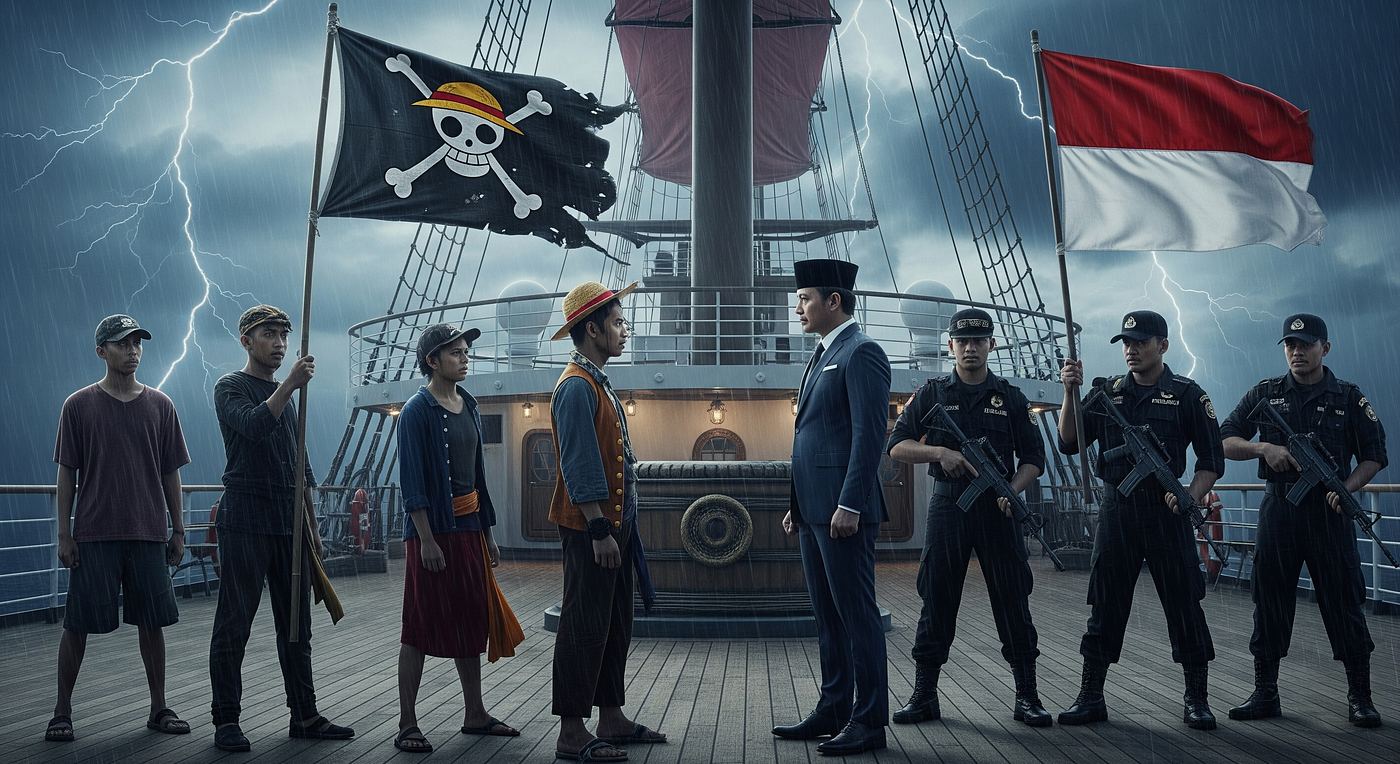
In recent years, a striking yet unassuming image has emerged as a potent emblem of defiance across Indonesia—a cartoonish skull, often rendered in bold lines and vibrant colors. What might appear at first glance as a piece of street art or underground graphic design has, in reality, transformed into a unifying symbol for activists, artists, and ordinary citizens pushing back against oppression, corruption, and social injustice. This symbol’s journey from obscurity to prominence is not just a story about art; it is a reflection of Indonesia’s complex political landscape, the power of grassroots movements, and the enduring human desire for freedom and expression.
Determining the precise beginnings of the cartoon skull as a representation of resistance is challenging, as it arose naturally from Indonesia’s underground art and protest communities. Unlike government-approved imagery or corporate trademarks, this symbol wasn’t created through formal means. Rather, it originated from the streets—stenciled on walls, featured on homemade protest signs, and distributed on social media by those opposing authority.
Some trace its roots to the punk and anarchist subcultures that have long thrived in Indonesia’s urban centers. Others link it to the DIY (do-it-yourself) ethos of independent artists who use bold, easily reproducible imagery to bypass censorship. The skull’s exaggerated features—often grinning, sometimes adorned with slogans or motifs—make it instantly recognizable, allowing it to spread quickly among activists who need symbols that can be replicated under oppressive conditions.
The depiction of skulls has been prominent in art and symbolism to signify themes of revolt, death, and resistance. Ranging from the infamous pirate flag, Jolly Roger, to the calaveras associated with Mexican Day of the Dead customs, skull representations hold a global significance. In Indonesia, the illustration of skulls in cartoons adds further layers of interpretation.
For instance, its whimsical yet disquieting look serves as a powerful means for satire. With a caricature-like approach, creators and activists undermine the dread usually linked to skulls, transforming it into a symbol that ridicules power instead of submitting to it. The overstated smile might be interpreted as a sneer at dishonest leaders, exploitative companies, or harsh regulations.
Additionally, the simplicity of the skull is crucial to its effectiveness as a symbol of resistance. In contrast to intricate political manifestos or elaborate slogans, a thoughtfully created image can instantly express opposition. It transcends translation, overcomes literacy challenges, and allows for limitless adaptation—whether it’s spray-painted on a protest sign, featured on a T-shirt, or distributed as a digital sticker.
A considerable part of the rapid diffusion of the cartoon skull can be attributed to social media. In a nation where traditional media is frequently managed or swayed by political elites, platforms such as Twitter, Instagram, and Telegram have emerged as essential venues for expressing dissent. Activists utilize these platforms to disseminate the symbol accompanied by hashtags connected to labor strikes, environmental demonstrations, and movements against corruption.
One reason the skull thrives online is its adaptability. Digital artists remix it, adding new elements to fit different causes—a gas mask for environmental protests, a chain breaking for workers’ rights, or a university cap for student movements. Each iteration reinforces the symbol’s core message while allowing different groups to claim it as their own.
Authorities have attempted to restrict its distribution, marking posts featuring the skull or even detaining people for showing it. However, these strict measures frequently have unintended consequences, as forceful actions only enhance the symbol’s appeal as a sign of defiance. The harder the government tries to eliminate it, the more it turns into a symbol of pride for those who oppose.
Indonesia has a complex relationship with opposition. Although the nation moved towards democracy following the collapse of Suharto’s authoritarian rule in 1998, the right to free speech continues to be challenged. Legislation against defamation, blasphemy, and “inciting hatred” is frequently utilized to silence opponents, and symbols of protest are often outlawed.
The cartoon skull has faced similar scrutiny. Authorities have labeled it as “anarchist,” “subversive,” or even linked it to extremist groups in an effort to discredit its users. Police have detained protesters for carrying banners featuring the skull, and state-aligned media occasionally runs segments warning against its “dangerous influence.”
Yet, rather than fading away, the symbol has only grown stronger. Each attempt to suppress it reinforces its role as a marker of resistance. When the government treats a drawing as a threat, it inadvertently confirms the power of art as a tool of protest.
The cartoon skull is not unique in its function—it joins a long history of symbols adopted by resistance movements worldwide. The raised fist, used by Black Power activists and labor movements, conveys solidarity and strength. The Guy Fawkes mask, popularized by V for Vendetta and Anonymous, represents anonymity and rebellion against tyranny. Even something as simple as a safety pin has been worn as a sign of solidarity with marginalized groups.
What makes Indonesia’s skull distinct is its deep connection to local struggles. It is not an imported symbol but one that emerged organically from the country’s own history of dissent. It resonates because it reflects Indonesian humor, resilience, and creativity in the face of adversity.
As long as inequality, corruption, and repression persist in Indonesia, the cartoon skull will likely remain a fixture of protest culture. Its meaning may shift—what represents labor rights today might symbolize climate justice tomorrow—but its core function as a tool of defiance endures.
Possibly the most notable feature of this emblem is its widespread availability. It is not owned by any individual or organization; rather, it is available to anyone who chooses to use a spray can, post a picture on the internet, or display it proudly. In an era where opposition is more frequently monitored and suppressed, the ability of a straightforward illustration to continue to disturb authorities highlights the lasting power of united defiance.
The cartoon skull’s rise from underground art to national symbol of defiance is a reminder that resistance does not always come in the form of grand speeches or armed uprisings. Sometimes, it is a grinning face on a wall, a shared image on a phone, or a sticker slapped onto a street sign.
In Indonesia, where freedom of expression is often under threat, the persistence of this symbol proves that ideas cannot be easily erased. The skull is more than just an image—it is a statement, a challenge, and a promise that the fight for justice will continue, one bold stroke at a time.